Spannzangen schlagen Backenfutter bei kleinen Durchmessern mit vollflächiger Spannung und Zentrierung der Klasse 0,005 mm. BQUQ fertigt beides, ISO9001, Angebot in 12 Stunden.
Spannzangen vs. Backenfutter: Präzisions-Spannmittel für kleine Durchmesser
Bei der Bearbeitung von Stangenmaterial mit kleinem Durchmesser schlagen Spannzangen Backenfutter bei den beiden entscheidenden Kennzahlen – Zentrierung und Wiederholgenauigkeit –, weil eine Spannzange den vollen Umfang mit einer Bohrung umschließt, die konzentrisch zu ihrem Konus geschliffen ist, während ein Futter die Kraft auf drei oder sechs Backen konzentriert und mehr bewegliche Teile aufweist. Spannzangen halten typischerweise Rundlauf in der Klasse 0,005 mm; Backenfutter bei kleinen Durchmessern laufen werkseitig typischerweise eine Größenordnung ungenauer. Futter punkten bei Spannbereich, roher Spannkraft und großen Durchmessern.
Die Argumentation Spannzange gegen Futter ist im Grunde eine Frage des Durchmessers. Unterhalb von etwa 25–30 mm sind Spannzangen die Präzisionslösung: Sie zentrieren besser, wiederholen besser und laufen genauer, weil ihre Geometrie einfacher ist – eine geschliffene Bohrung, ein geschliffener Konus und keine Backenmechanik, die verschleißt. Oberhalb dieses Bereichs und immer dann, wenn das Werkstück stark in der Größe variiert, übernehmen Backenfutter, weil sie alles innerhalb ihres Backenhubs spannen und eine Spannkraft liefern, die keine geschlitzte Spannzange erreicht. Die richtige Wahl pro Aufgabe zu treffen, ist besser, als eine Seite als universelle Antwort zu verteidigen.
Was jedes System tatsächlich ist
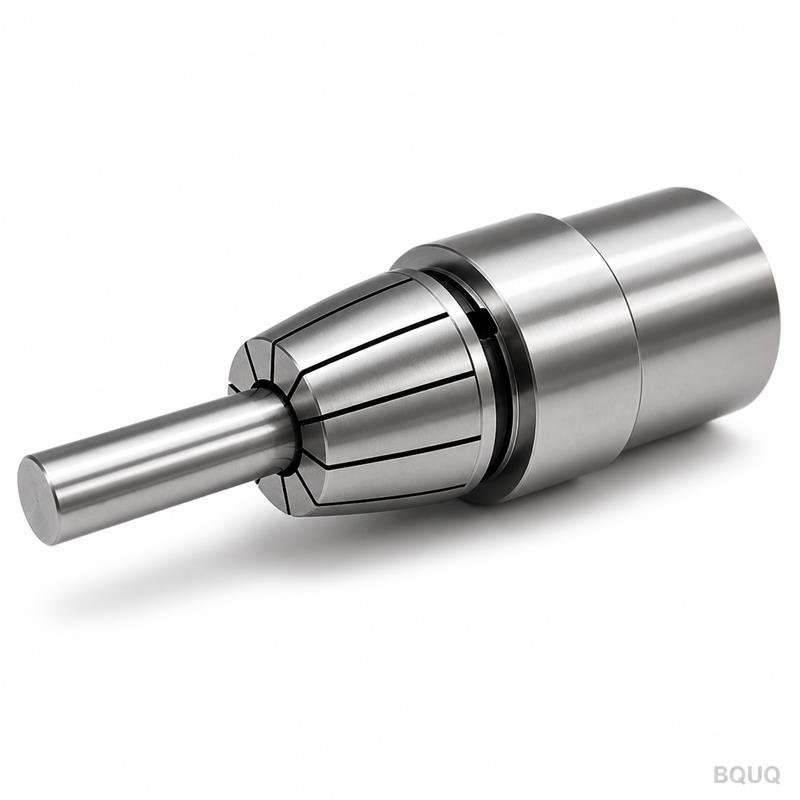
Ein Spannzangen-Spannsystem ist eine konische Hülse (oder ein Futter, das eine solche hält), die sich um den vollen Umfang des Materials schließt. In seiner einfachsten Form – die Spannzange an einer Automatendrehmaschine oder Schweizer Drehmaschine – wird die Hülse in einen Konus gezogen, und die geschlitzten Finger schließen sich gleichmäßig. Die Spannung ist durchgehend um die Stange, und die Bohrung, die spannt, ist dieselbe Fläche, die konzentrisch zum Sitzkonus geschliffen wurde.
Ein Backenfutter ist ein Mechanismus: Eine Planscheibe oder ein Keilring bewegt drei, vier oder sechs Backen gleichzeitig nach innen. Die Backen greifen an einzelnen Punkten oder kurzen Bögen, und der Mechanismus zwischen Betätigung und Werkstück – Planscheibe, Führungen, Backenaufnahme – weist Spiel, Verschleiß und Durchbiegung auf, die Spannzangen nicht haben.
| Eigenschaft | Spannzange (Feder) | Backenfutter (3-Backen selbstzentrierend) |
|---|---|---|
| Spannkontakt | Voller Umfang | 3 Punkte/Bögen |
| Typischer Rundlauf, kleiner Durchmesser | Klasse 0,005–0,010 mm | Typisch 0,02–0,05 mm, werkseitig |
| Spannbereich | Eine Größe ± kleines Fenster | Backenhub, breit |
| Spannkraft | Moderat, durch Zugrohr begrenzt | Hoch, mechanisch vervielfacht |
| Bewegliche Teile | Keine (Hülse federt) | Planscheibe/Keil, Backen, Führungen |
| Verschleißteile | Bohrung, Konus | Backenführungen, Planscheibe, Backen |
| Bester Durchmesserbereich | Klein (etwa unter 25–30 mm) | Mittel bis groß |
Die Zahlen sind typische Branchenwerte, kein Spezifikationskrieg – ein geschliffenes und ausgerichtetes Futter mit weichen Backen kann sich dem Rundlauf einer Spannzange nähern, und eine Spannzange in einem verschmutzten Konus kann schlechter laufen als ein gutes Futter. Der strukturelle Punkt bleibt: Die Spannzange hat weniger Fehlerquellen.
Warum Spannzangen besser zentrieren
Die Zentrierung bei einer Spannzange beruht auf Geometrie; die Zentrierung bei einem Futter beruht auf einem Mechanismus. Die Spannzangenbohrung ist in derselben Aufspannfamilie wie der Sitzkonus geschliffen, sodass die Bohrung bei gesetztem Konus innerhalb der Rundlaufklasse der Spannzange auf der Spindelachse sitzt. Die Spannkraft wird gleichmäßig um den Umfang durch Finger aufgebracht, die gleichmäßig federn – es gibt keine Backe, die auf einer Seite stärker spannt.
Ein Backenfutter zentriert, indem es drei Backen um gleiche Distanzen bewegt – was nur so gut funktioniert, wie der Planscheiben- oder Keilmechanismus gefertigt und gewartet ist. Verschleiß an den Backenführungen, Planscheibenspiel und Fehler in der Backenaufnahme addieren Exzentrizität, und die Fehler wachsen, je weiter die Backen von der Mitte ausgefahren sind. Bei kleinen Durchmessern, wenn die Backen nahe ihrer inneren Grenze sind, werden die absoluten Fehler des Mechanismus zu einem großen Anteil der Teilegröße.
| Fehlerquelle | Spannzange | Backenfutter |
|---|---|---|
| Geometrie der Spannung | Bohrung auf Konus geschliffen | Backenpositionen aus Mechanik |
| Verschleißwirkung | Langsamer Bohrungs-/Konusverschleiß | Planscheibe, Führungen, Backen verschleißen alle |
| Symmetrie der Spannkraft | Konstruktionsbedingt gleichmäßig | Abhängig vom Zustand der Backen/Planscheibe |
| Effekt der Teilegröße | Klasse hält bei jeder Bohrung | Fehler wachsen bei kleinen Durchmessern |
| Wiederholgenauigkeit beim erneuten Spannen | Sehr hoch | Gut bis mäßig |
Wiederholgenauigkeit: Die Produktionskennzahl
Für die Produktion ist die Wiederholgenauigkeit oft wichtiger als die absolute Genauigkeit: Das Teil muss in jedem Zyklus, Zyklus für Zyklus, in dieselbe Mitte zurückkehren. Spannzangen sind hier der Maßstab. Dieselbe Spannzange, die dieselbe Stangengröße spannt, kehrt im Wesentlichen in dieselbe Position zurück, weil sich nichts bewegt außer der elastischen Verformung der Finger, und die Finger kehren durch Federwirkung in dieselbe Bohrung zurück.
Backenfutter wiederholen gut, wenn sie in Ordnung sind, aber sie wiederholen durch einen Mechanismus – und Mechanismen driften. Nachgeschliffene oder neu geschnittene Backen, Späne in der Planscheibe und thermische Veränderungen im Futterkörper verschieben das Spannzentrum zwischen den Zyklen. Bei Arbeiten, die Zehntel auf Durchmesser und Position halten, ist diese Drift der Unterschied zwischen einem stabilen Prozess und einem, der ständige Nachjustierung erfordert. Wenn die Produktion jedoch viele Teilegrößen auf einer Maschine mischt, schlägt die sofortige Bereichseinstellung des Futters den Wechsel von Spannzangen – weshalb beide in derselben Werkstatt leben.
Spannkraft und Steifigkeit
Der ehrliche Vorteil des Backenfutters ist die Kraft. Ein Keil- oder Hebelspannfutter vervielfacht die Zugrohr- oder Hydraulikkraft in eine Backenspannkraft, die eine geschlitzte Spannzange nicht erreichen kann, und diese Kraft hält große oder unterbrochen geschnittene Werkstücke starr. Spannzangen spannen mit der Zugrohrkraft, die über den Konus verteilt wird – ausreichend für stangenbeschicktes Drehen und Schlichten, grenzwertig für schweres Schruppen großer Querschnitte.
Der Kompromiss ist Markierung und Verformung. Eine Spannzange verteilt ihre (geringere) Spannkraft über den vollen Umfang, sodass sie weiches oder dünnwandiges Material weniger markiert als Backen, die die Kraft an drei Punkten konzentrieren. Bei dünnwandigen Rohren und fertig bearbeiteten Oberflächen macht das die Spannzange trotz geringerer Gesamtkraft zur schonenderen Wahl – die Kraftverteilung, nicht nur die Kraftgröße, entscheidet über die Verformung.
| Auftragsmerkmal | Spannzange bevorzugt | Backenfutter bevorzugt |
|---|---|---|
| Stangendurchmesser unter ~25 mm | Stark | — |
| Große Durchmesser | — | Stark |
| Breite Größemischung auf einer Maschine | — | Stark |
| Schweres Schruppen, unterbrochene Schnitte | — | Stark |
| Dünnwandiges / weiches Material | Stark | — |
| Schlichtarbeiten mit Zehntel-Toleranz | Stark | — |
| Schneller Umbau zwischen Teilen | — (wenn Spannzangenwechsel schnell ist) | Stark |
Spannbereich: Der entscheidende Sieg des Futters
Der Bereich ist, wo das Futter schlicht keine Konkurrenz hat. Ein 3-Backenfutter spannt jede Stange innerhalb seines Backenhubs – von wenigen Millimetern bis zu seiner Kapazität – während eine Spannzange eine Größe plus einen Bruchteil eines Millimeters spannt. Ein Lohnfertiger, der jede Stunde einen anderen Durchmesser bearbeitet, kann nicht jede Stunde Spannzangen wechseln; er fährt ein Futter. Eine Produktionslinie, die ein Jahr lang dieselbe Stange verarbeitet, kann den Rundlauf eines Futters nicht rechtfertigen, wenn eine Spannzange die Toleranz zu geringeren Kosten hält.
Der moderne Mittelweg ist das Spannzangenfutter: ein Futterkörper, der Spannzangen aufnimmt, was dem Bediener den Montagekomfort eines Backenfutters mit Zentrierung in Spannzangenqualität bietet, sowie Schnellwechselsysteme, die Spannzangen in Sekunden tauschen. An Automaten- und Schweizer Drehmaschinen ist das Spannzangenfutter der Standard für die Werkstückhaltung; an allgemeinen CNC-Drehmaschinen ist es eine Option, die gewählt wird, wenn Präzision bei kleinen Stangen die Arbeit dominiert. Unser Leitfaden für 2J-Spannzangenfutter behandelt die gängigste Spannzangenfutter-Familie für Schweizer und Automatenmaschinen.
Welches sollten Sie kaufen?
Wenden Sie den Durchmesser- und Mischtests an. Wenn die Arbeit Stangenmaterial unter etwa 25–30 mm ist, enge Toleranzen hält und in angemessenen Stückzahlen läuft, sind Spannzangen oder ein Spannzangenfutter die Präzisionsantwort – und an stangenbeschickten Maschinen gibt es keine echte Wahl, da die Maschinenarchitektur Spannzangen erfordert. Wenn die Arbeit groß, in der Größe variabel oder stark unterbrochen ist, ist ein Backenfutter die praktische Antwort, und sein Rundlauf wird mit weichen Backen und Ausrichten gemanagt, nicht eliminiert.
Für Werkstätten, die beides machen, ist das Standardlayout ein Futter für den Bereich und ein Spannzangenfutter für die Präzisionsstangenarbeiten, getauscht pro Einrichtung. Wenn die Präzisionsarbeit dominiert, kaufen Sie zuerst das Spannzangensystem und behalten das Futter für die Sondergrößen. BQUQ fertigt beide Seiten dieser Entscheidung – Automatenspannzangen in den Familien 36/46/52/60/630/643 für die Kleinstangenarbeit und Schweizer/2J-Spannzangenfutter für Maschinen, die auf Spannzangen-Werkstückhaltung ausgelegt sind – alle auf die Klasse 0,005 mm unter ISO9001-Kontrolle in einer Fabrik in Dongguan geschliffen. Sehen Sie sich das Sortiment an Automatenspannzangen und die Schweizer und 2J-Spannzangenfutter an, lesen Sie den Leitfaden für Automatenspannzangen für das Familiensystem, und senden Sie Ihre Teilegrößen und Toleranzen an sc@bquq.com für eine Empfehlung und ein Angebot innerhalb von 12 Arbeitsstunden.
Häufig gestellte Fragen
F: Warum sind Spannzangen bei kleinen Teilen genauer als Backenfutter?
A: Eine Spannzange spannt mit einer Bohrung, die konzentrisch zu ihrem Konus geschliffen ist, ohne Mechanik zwischen Sitz und Werkstück. Ein Backenfutter zentriert über eine Planscheibe oder einen Keil mit Backen, Führungen und Verschleiß – jedes fügt Fehler hinzu, die bei kleinen Durchmessern am stärksten ins Gewicht fallen.
F: Wann sollte ich ein Backenfutter anstelle einer Spannzange verwenden?
A: Wenn die Durchmesser groß sind, die Größen häufig wechseln oder der Schnitt schwer genug ist, um Spannkraft auf Backenniveau zu benötigen. Ein Futter spannt alles in seinem Backenhub; eine Spannzange spannt eine Größe. Bereich und Kraft sind die Existenzgründe des Futters.
F: Kann ein Backenfutter so genau sein wie eine Spannzange?
A: Mit an Ort und Stelle gebohrten weichen Backen und sorgfältigem Ausrichten kann sich ein Futter für einen bestimmten Teiledurchmesser der Spannzangengenauigkeit nähern. Aber es muss für jede neue Größe neu eingerichtet werden, während die Genauigkeit der Spannzange eingebaut ist. Spannzangen gewinnen bei Komfort und Konsistenz.
F: Beschädigen Spannzangen weiches oder dünnwandiges Material?
A: Weniger als Backen. Eine Spannzange verteilt ihren Griff über den vollen Umfang, sodass der Druck gleichmäßig ist; Backen konzentrieren die Kraft an drei Punkten. Bei dünnwandigen Rohren kann eine entlastete Spannzangenbohrung den Griff weiter verteilen und weicher machen.
F: Was ist ein Spannzangenfutter und wie unterscheidet es sich von einem Backenfutter?
A: Ein Spannzangenfutter ist ein Futterkörper, der Spannzangen anstelle von Backen aufnimmt und so schnelle Montage mit Zentrierung in Spannzangenqualität kombiniert. Es spannt eine Stangengröße pro Spannzange und eignet sich daher besser für Produktionsläufe mit gleichbleibender Stange als für Lohnfertigung mit gemischten Größen.
Verfasst vom BQUQ-Ingenieurteam. BQUQ ist eine ISO9001-zertifizierte Quellenfabrik in Dongguan, China, die CNC-Bearbeitung, Metallstanzen, kundenspezifische Federn, Kühlkörper und Spannzangenlinien unter einem Dach betreibt. Senden Sie Zeichnungen an sc@bquq.com oder WhatsApp +86 13713157787 für ein Angebot innerhalb von 12 Arbeitsstunden. www.bquq.com