Konstruieren Sie stranggepresste Kühlkörperprofile, die tatsächlich pressbar sind: Mindestrippen- und Wandstärke, Rippenverhältnis und Matrizengrenzen. BQUQ (ISO9001, Dongguan) bietet Angebote innerhalb von 12 Stunden.
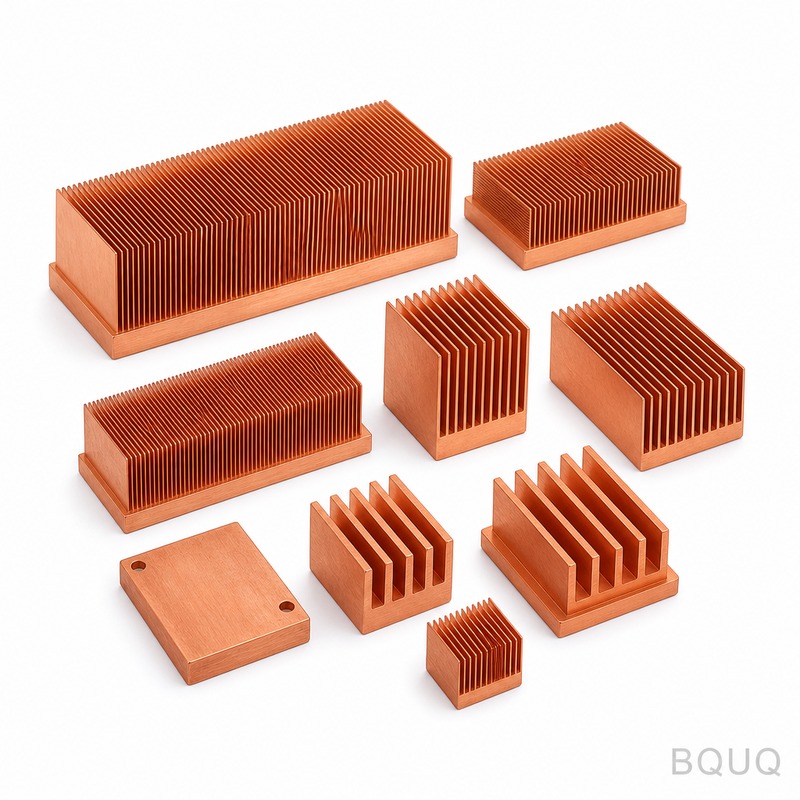
Konstruktion für Aluminiumstrangpressen: Rippenverhältnisse, Wandstärken und Matrizengrenzen
Ein stranggepresstes Kühlkörperprofil ist nur so gut wie seine Matrize, und Matrizen haben harte Grenzen: Mindestrippenstärke etwa 1,0–1,3 mm für 6063, Mindestwandstärke etwa 1,2–1,5 mm, wirtschaftliche Rippenhöhen-zu-Spalt-Verhältnisse nahe 6–8 zu 1 und eine Profilhüllkurve, die in die Presse passen muss. Konstruieren Sie innerhalb dieser Grenzen, und das Profil lässt sich schnell pressen, hält die Maße und kostet wenig; konstruieren Sie außerhalb dieser Grenzen, und Sie zahlen für langsame Läufe, kurze Matrizenlebensdauer und Toleranzprobleme in jeder Charge.
Strangpressen klingt nachsichtig – heißes Aluminium durch ein Loch drücken und auf Länge schneiden. In der Praxis ist die Matrize ein Präzisionswerkzeug, das den Metallfluss über jede Rippe ausbalancieren muss, und die Profilgeometrie entscheidet, wie gut diese Balance gelingt. Dieser Leitfaden zeigt die Zahlen, die ein Konstrukteur benötigt, bevor das Profil gezeichnet wird, damit die Form, die in CAD großartig aussieht, auch eine Form ist, die eine Presse tatsächlich herstellen kann.
Der Käfig der Rippengeometrie: Dicke, Spalt und Verhältnis
Rippen sind das Herzstück eines thermischen Profils und die am schwierigsten zu strangpressenden Merkmale. Metall muss in jede dünne Rippe fließen und sie vollständig füllen; ist die Rippe im Verhältnis zu ihrer Höhe zu dünn, kühlt die Vorderkante ab, bevor sie gefüllt ist, und Sie erhalten kurze oder gerissene Rippen. Die praktischen Zahlen der Branche liegen eng beieinander, weil sich die Physik zwischen den Pressen nicht stark unterscheidet.
| Konstruktionsparameter | Praktische Strangpressgrenze (typ., 6063) | Was jenseits der Grenze passiert |
|---|---|---|
| Mindestrippenstärke | 1,0–1,3 mm | Rippen werden unvollständig gefüllt oder reißen; Matrizenlebensdauer sinkt drastisch |
| Mindestwandstärke | 1,2–1,5 mm | Wellige Wände, schwierige Maßhaltigkeit |
| Mindestspalt zwischen Rippen | ~1,3–1,5 mm | Metall kann nicht fließen; Schlitze verschweißen |
| Rippenhöhen-zu-Spalt-Verhältnis | ~6–8:1 wirtschaftlich | Langsame Presse, empfindliche Matrize, schlechte Füllung |
| Maximale Rippenhöhe | ~100–150 mm Profil | Darüber leiden Toleranzen und Geschwindigkeit |
| Umkreis des Profils | ~200–250 mm typisch | Muss in den Presscontainer passen |
Wichtigste Erkenntnis: Das Verhältnis ist die Zahl, die Konstrukteure am häufigsten verletzen. Eine 40 mm hohe Rippe benötigt einen Spalt von mindestens 5–7 mm, um im wirtschaftlichen Bereich zu bleiben – was praktischerweise dem entspricht, was die thermische Auslegung für natürliche Konvektion ohnehin verlangt. Wenn Ihre thermische Analyse höhere, dünnere oder dichtere Rippen erfordert, als es der Käfig zulässt, sollte der Prozess auf CNC-Bearbeitung, Schälen oder Fügen umgestellt werden, anstatt die Matrize zu erzwingen.
Wandstärkengleichmäßigkeit und Metallfluss
Aluminium fließt durch eine Matrize wie Wasser durch ein Rohrnetz – es nimmt den Weg des geringsten Widerstands. Rippen, Zungen und dünne Wände widerstehen dem Fluss; dicke Abschnitte lassen das Metall vorauseilen. Wenn der Querschnitt sehr dicke und sehr dünne Bereiche mischt, kommt das Pressergebnis verdreht, verbogen oder mit dünnen Abschnitten heraus, die nie gefüllt werden – egal wie gut der Matrizenstahl ist.
| Querschnittscharakter | Wirkung auf das Profil | Konstruktive Lösung |
|---|---|---|
| Durchgehend gleichmäßige Wände | Gerade, stabil, schnelle Presse | Darauf abzielen |
| Dicke Basis + dünne Rippen (normale Kühlkörper) | Beherrschbar – die klassische Form | Basisverhältnis moderat halten |
| Abrupte dick-zu-dünn-Übergänge | Welligkeit, Verwindung, Füllfehler | Konische oder radiale Übergänge hinzufügen |
| Tiefe schmale Zunge (langes dünnes Merkmal) | Zunge biegt oder bricht in der Matrize | Verkürzen oder Unterstützung hinzufügen |
| Starke Asymmetrie | Profil krümmt oder verwindet sich nach der Matrize | Metallverteilung ausgleichen oder Teil teilen |
Wichtigste Erkenntnis: Betrachten Sie den Querschnitt zuerst als Fließproblem, bevor Sie ihn als Geometrieproblem behandeln. Ein kleiner Radius an der Basis jeder Rippe und ein allmählicher Übergang zwischen dicken und dünnen Bereichen kostet nichts in CAD und spart unendlich viel Ärger an der Presse und beim Richten.
Toleranzen: Was ein Strangpressprofil tatsächlich halten kann
Strangpressteile sind keine bearbeiteten Teile, und wenn Sie sie wie bearbeitete Teile anbieten, sind Enttäuschungen vorprogrammiert. Querschnittsmaße eines gut konstruierten Profils halten typischerweise etwa ±0,3–0,5 mm, abhängig von der Größe, wobei engere Kontrolle bei kritischen Merkmalen gegen Aufpreis möglich ist. Geradheit, Verwindung und Länge sind separate Spezifikationen. Was die meisten Konstruktionen rettet, ist die Erinnerung daran, dass die Montagefläche – die Oberfläche, die die thermische Schnittstelle trägt – nicht strangpressgenau sein muss; sie wird später bearbeitet.
| Maß oder Merkmal | Typische Strangpresstoleranz | Hinweis |
|---|---|---|
| Querschnittsmaße | ±0,3–0,5 mm (abhängig von der Profilgröße) | Standard kommerzielles Strangpressen |
| Kritisches Merkmal, lokal gehalten | ±0,1–0,25 mm möglich | Kostet Geschwindigkeit; nur wo nötig |
| Schnittlänge | ±1 mm oder besser | Mit einer Säge günstig zu präzisieren |
| Geradheit | Gemäß EN 755 / Lieferantenstandard | Beeinflusst durch Wärmebehandlung |
| Verwindung | Gemäß EN 755 / Lieferantenstandard | Schlimmer bei asymmetrischen Profilen |
| Ebenheit der Montagefläche | Nach dem Strangpressen bearbeitet | Nicht von der Matrize erwarten |
Wichtigste Erkenntnis: Setzen Sie Präzision dort ein, wo sie zählt – auf bearbeiteten Montageflächen und Lochbildern – und lassen Sie das Strangpressprofil überall sonst ein Strangpressprofil sein. Die klassische Arbeitsteilung: Strangpressen erzeugt Rippen und die grobe Hüllkurve kostengünstig; ein leichter Bearbeitungsgang macht die Basis eben, die Löcher präzise und die thermische Schnittstelle zuverlässig.
Legierungswahl: Leitfähigkeit vs. Festigkeit
Bei thermischen Profilen ist die Legierungsentscheidung fast immer 6063-T5 gegenüber 6061-T6. Der Leitfähigkeitsunterschied ist real und geht in die Richtung, die Anfänger am wenigsten erwarten: 6063 leitet besser als 6061, weil sein Legierungsgehalt niedriger ist, während 6061 in strukturellen Abschnitten fester und besser bearbeitbar ist.
| Eigenschaft (typ.) | 6063-T5 | 6061-T6 |
|---|---|---|
| Wärmeleitfähigkeit | ~200 W/m·K | ~155–170 W/m·K |
| Streckgrenze | ~130–180 MPa | ~240–280 MPa |
| Strangpressbarkeit | Ausgezeichnet – Standard für Rippen | Gut, aber schwerer zu pressen |
| Typische Verwendung | Kühlkörper, thermische Profile | Strukturelle Basen, Montageplatten |
Wichtigste Erkenntnis: Verwenden Sie 6063 für Rippenabschnitte, wo die Leitfähigkeit führt, und 6061, wo das Profil gleichzeitig als Strukturelement dient. Rippen aus 6063 auf einer bearbeiteten Basis aus 6061 ist eine legitime Kombination, wenn die Basis Last trägt – und eine natürliche Aufgabe für eine CNC-bearbeitete Kühlkörper-Basis, die mit einem stranggepressten Rippenabschnitt verbunden wird.
Konstruktionsprüfung vor dem Matrizenschnitt
Der günstigste Zeitpunkt, ein Pressproblem zu erkennen, ist bevor die Matrize existiert. Prüfen Sie das Profil anhand dieser Fragen: Ist jede Rippe über 1,0 mm dick und jeder Spalt über 1,3 mm, liegt das Höhen-zu-Spalt-Verhältnis innerhalb von 8:1, sind die Wandstärken einigermaßen gleichmäßig, ist das Profil einigermaßen symmetrisch oder zumindest flussausgeglichen, und passt der Umkreis in die Presse? Wenn die Antwort auf eine Frage nein ist, ist die Lösung entweder eine Geometrieänderung oder ein anderer Prozess. Senden Sie den fertigen Querschnitt mit einem Hinweis auf Länge, Legierung und welche Flächen bearbeitet werden an einen Strangpresslieferanten, und die Matrizenkonstruktionsprüfung bestätigt den Rest. BQUQ betreibt seine thermische Linie rund um stranggepresste Kühlkörper, die intern geschnitten und bearbeitet werden, wobei der Kostenfaktoren-Leitfaden zeigt, wie sich Matrizen- und Profilschwierigkeit in Preise übersetzen – senden Sie die Profilzeichnung an sc@bquq.com, und das 12-Stunden-Angebot enthält eine klare Antwort, ob die Form gut presst oder gegen Sie arbeitet.
Häufig gestellte Fragen
F: Was ist die Mindestrippenstärke für einen stranggepressten Aluminiumkühlkörper?
A: Etwa 1,0–1,3 mm für 6063-Profile in normaler Produktion. Darunter werden Rippen unvollständig gefüllt oder reißen, und die Matrizenlebensdauer sinkt drastisch. Wenn das thermische Design dünnere Rippen erfordert, ist die ehrliche Lösung eine geschälte, gefügte oder CNC-bearbeitete Konstruktion.
F: Was ist das maximale Rippenhöhen-zu-Spalt-Verhältnis für das Strangpressen?
A: Wirtschaftliches Strangpressen bleibt nahe 6–8 zu 1. Ein höheres Verhältnis presst langsam, füllt schlecht und verschleißt die Matrize schnell. Das natürliche Konvektionsoptimum von 6–10 mm Rippenspalten liegt praktischerweise innerhalb des Strangpresskäfigs für Rippen bis etwa 60–80 mm Höhe.
F: Welche Toleranz kann ein stranggepresstes Profil halten?
A: Querschnittsmaße halten typischerweise ±0,3–0,5 mm, abhängig von der Profilgröße, mit lokalen Merkmalen bis etwa ±0,1–0,25 mm gegen Aufpreis. Präzisionsmontageflächen sollten nach dem Strangpressen bearbeitet werden, anstatt sie von der Matrize zu erwarten.
F: Welche Aluminiumlegierung ist am besten für stranggepresste Kühlkörper geeignet?
A: 6063-T5 für die Rippen selbst – es leitet etwa 200 W/m·K und lässt sich leicht strangpressen. Verwenden Sie 6061-T6, wenn das Profil auch strukturelle Lasten tragen muss, und akzeptieren Sie seine geringere Leitfähigkeit von etwa 155–170 W/m·K.
F: Warum kommt mein stranggepresstes Profil verdreht oder verbogen heraus?
A: Fast immer durch ungleichmäßigen Metallfluss verursacht, der durch asymmetrische Querschnitte oder abrupte dick-zu-dünn-Übergänge entsteht, manchmal kombiniert mit Wärmebehandlung. Konstruieren Sie für ausgeglichenen Fluss und gleichmäßige Wände neu oder akzeptieren Sie das Richten nach dem Strangpressen als zusätzliche Operation und Kosten.
Verwandte Artikel
- heat-sink-fin-design-guidelines – Mehr aus der BQUQ Thermal Management Engineering-Serie.
- heat-sink-cost-factors – Mehr aus der BQUQ Thermal Management Engineering-Serie.
- cnc-machined-heat-sinks-guide – Mehr aus der BQUQ Thermal Management Engineering-Serie.
Verwandte Ressourcen
- Über BQUQ: eine ISO9001-zertifizierte Quellfabrik in Dongguan mit vier Produktionslinien unter einem Dach.
- Kühlkörper und thermische Teile: stranggepresste, CNC-bearbeitete und gestanzte Optionen aus der thermischen Linie – stranggepresste Kühlkörper, CNC-bearbeitete Kühlkörper, gestanzte Kühlkörper.
- Branchentrends: Fertigungs-, Materialmarkt- und Beschaffungsanalysen für Käufer.
- Technische Artikel: Engineering-Leitfäden und Prozessvergleiche – mehr, wo dieser Artikel herkommt.
- FAQ-Hub: Schnelle Antworten zu CNC, Stanzen, Federn und Kühlkörpern.
- Fallstudien: Echte Teile und echte Zahlen aus Projekten, die wir entwickelt und geliefert haben.
- Kontaktieren Sie uns: Senden Sie Ihre Zeichnung und erhalten Sie ein Angebot innerhalb von 12 Arbeitsstunden.
Verfasst vom BQUQ Engineering-Team. BQUQ ist eine ISO9001-zertifizierte Quellfabrik in Dongguan, China, die CNC-Bearbeitung, Metallstanzen, kundenspezifische Federn, Kühlkörper- und Spannzangenlinien unter einem Dach betreibt. Senden Sie Zeichnungen an sc@bquq.com oder WhatsApp +86 13713157787 für ein Angebot innerhalb von 12 Arbeitsstunden. www.bquq.com